Google Cloud has introduced Gemini for government services, now in preview, to help federal, state, and local agencies apply AI to everyday operations. The focus is on work shaped by regulations, sensitive information, legacy systems, and human accountability.
The offering combines government-specific instructions, connections to existing agency systems, partner-built agents, and centralized governance. Google says agencies can connect their systems without migrating data while preserving existing access permissions.
My take: The workflow is where AI earns its value
Government use cases are a useful test of enterprise AI because producing an answer is only one part of the job. That answer must reflect the applicable rules, respect access controls, cite supporting evidence, and fit an established approval process.
This announcement reinforces a broader shift I see across the industry: AI value increasingly comes from connecting models to institutional knowledge and operational systems. The model matters, but so do integration, information architecture, governance, and the people responsible for decisions.
From a systems economics perspective, agencies should measure the full cost of completing a task. A faster document review has limited value if employees spend the time saved correcting errors or checking unsupported conclusions.
The measures of success should include:
- Service delivery: Shorter processing times and smaller backlogs.
- Quality: Fewer errors, clearer explanations, and less rework.
- Accountability: Traceable evidence and meaningful human oversight.
- Economics: Lower cost per successfully completed case, including integration and review.
Because there is no one AI workload, there is no one KPI for AI. Government adoption will need to demonstrate value workflow by workflow. This preview gives Google an opportunity to show how governed agents can translate technical capability into better public service.
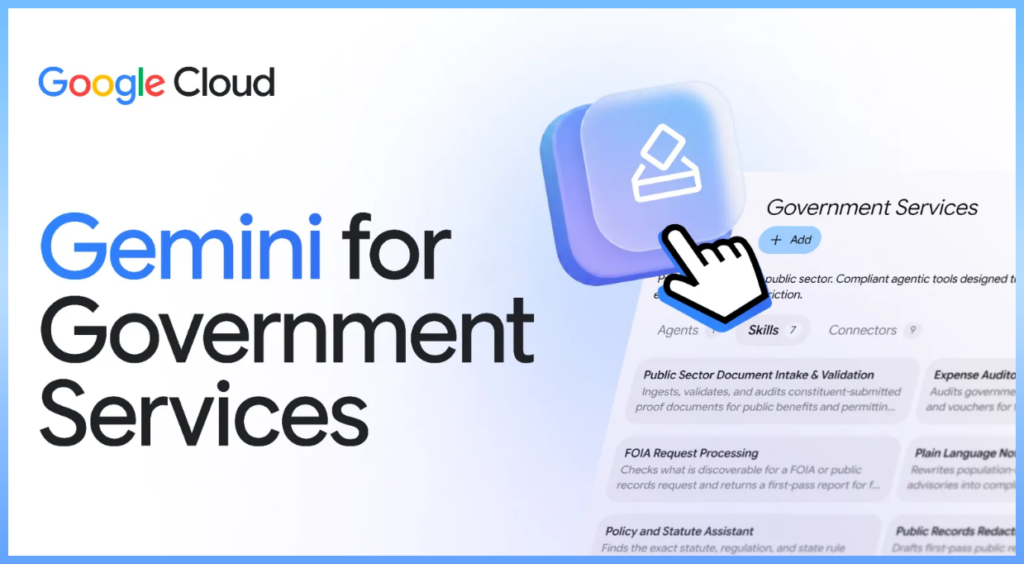
Where Google sees immediate applications
- Policy research: Find answers grounded in regulations and agency guidance.
- Public records requests: Locate and organize documents for Freedom of Information Act reviews.
- Document redaction: Identify sensitive information and propose redactions for human approval.
- Procurement: Evaluate vendor bids against requirements and document scoring.
- Grant audits: Flag questionable expenses and missing documentation.
- Application intake: Validate submitted documents and identify incomplete information.
- Public communication: Turn complex guidance into plain-language notices.
The platform supports connections across Oracle, Salesforce, ServiceNow, Google Workspace, and Microsoft 365. Its security foundation includes an option to deploy within Google Cloud’s Assured Workloads FedRAMP High Data Boundary. Google also says agency information will not be used to train its foundation models without permission.
More from Google on this announcement here.