Google has announced Gemini 4 Carbon, its latest frontier model, with notable improvements in agentic coding, long-horizon reasoning, and cybersecurity. The company says it will begin making Carbon available this week to a subset of trusted cyber defenders, with access expanding to additional partners through its Fairwind Program ahead of a broader rollout.
For enterprises and developers, the announcement points to a model designed to stay with complex tasks longer: investigating software issues, navigating large codebases, and helping security teams find and remediate vulnerabilities.
Stronger performance in coding and cybersecurity
Google says Carbon is designed for sustained agentic workflows. Its internal teams have used the model on multi-step engineering tasks including diagnosing and patching subtle bugs across large codebases and low-level systems. The company also reports improvements in generating secure code compared with Gemini 4 Argon.
In the benchmark results supplied by Google, Carbon scores 65.2% on Terminal-Bench 4.0, compared with 57.1% for Argon. On SWE-sweep, it scores 9.6%, up from 4.3%. On FrontierSWE 2, Carbon scores 61.2%, while GPT-6 Astra and Claude Opus 5.5 score 65.5% and 62.3%, respectively.
For cybersecurity, the reported scores are 88.2% on SEC-bench Pro, 54.8% on ExploitGym, and 71.0% on CWE-bench. These compare with Argon’s 83.4%, 42.0%, and 68.0%, respectively. Google says the cybersecurity benchmarks were evaluated without guardrails.
How Carbon compares across categories
The chart below shows the reported results across multiple categories, comparing Gemini 4 Carbon with the previous release, Gemini 4 Argon, and other frontier models. It covers general capabilities, agentic coding, computer use, knowledge work, multimodal understanding, long context, science and math, and cybersecurity.
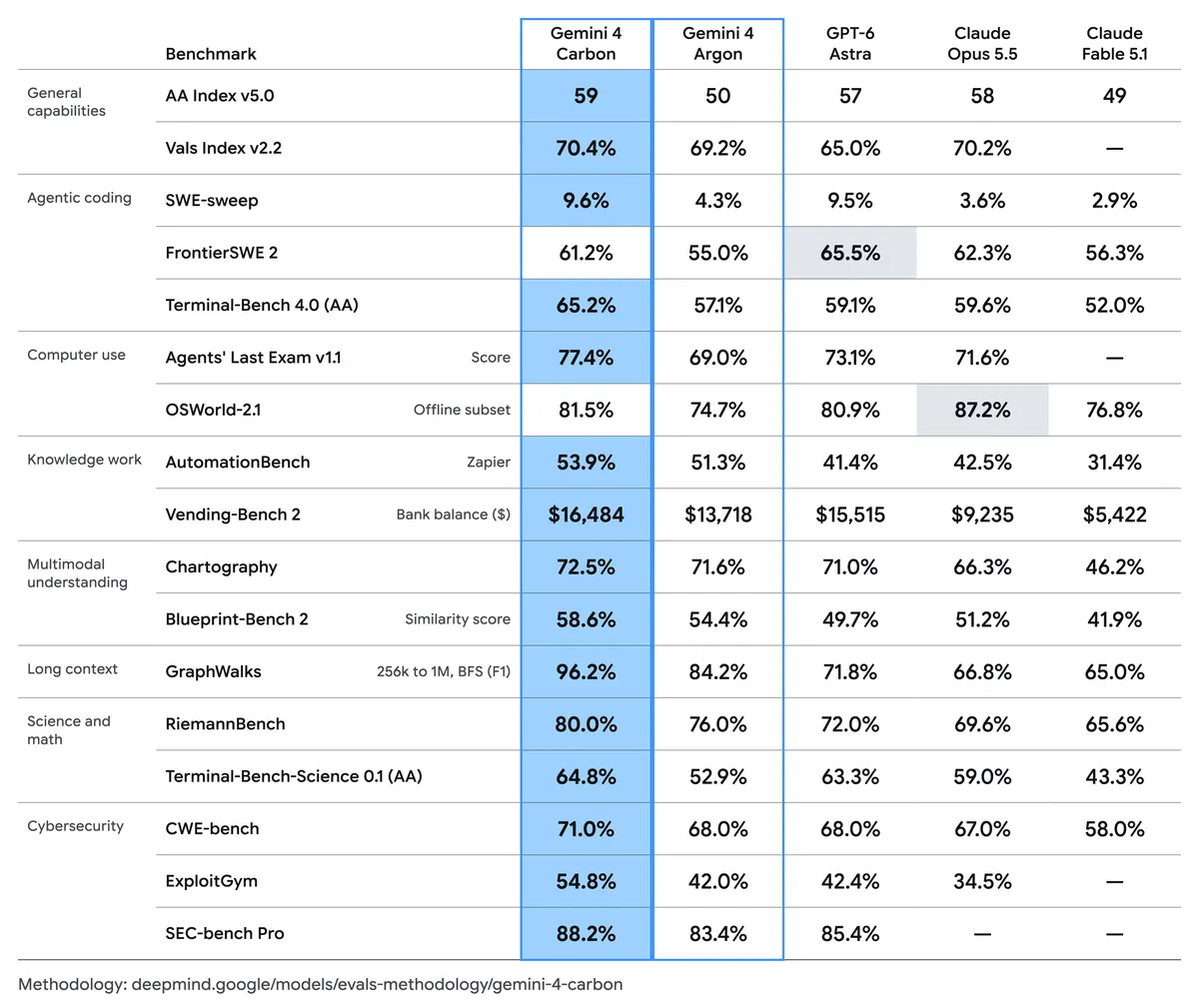
Carbon improves on Argon across the results shown, but it does not lead every comparison: Claude Opus 5.5 scores higher on OSWorld-2.1, and GPT-6 Astra scores higher on FrontierSWE 2. Benchmark results are useful signals, though real-world results will depend on the task, tools, deployment settings, and evaluation methodology.
A phased rollout through Fairwind
Google says it is taking a phased approach, starting with a subset of cyber defenders this week and gradually expanding access to trusted partners through the Fairwind Program. The company plans to gather feedback and refine guardrails before bringing Carbon to developers, businesses, and consumers. It has not given a firm date for wider availability.
Google also announced introductory pricing of $2 per million input tokens and $10 per million output tokens, with cached input tokens discounted by 95%. After the introductory period, the stated prices are $4 and $20 per million input and output tokens, respectively.
Stackpane perspective
The most meaningful shift to watch is how reliably these benchmark gains translate into production workflows. Better security analysis and longer-running coding agents could make a practical difference. Enterprises will still need to evaluate accuracy, human review, access controls, cost, and performance against their own code and operating environments. My advice is to test the model in smaller use cases and then expand the coverage. BTW, frequency of frontier model releases is making most Ops people scratching their heads!
For now, trusted defenders get the first look. The wider developer and enterprise community will have to hang tight.
Sources: Google’s Gemini 4 Carbon announcement and Google’s evaluation methodology.